
How to Identify a Blue Catfish (Ictalurus furcatus)
Quick answer
Blue Catfish, Ictalurus furcatus: the 6 field marks to check, size, habitat and North American range, with sources. How to tell it from Channel Catfish.
Updated 2026-09-25 · Sources: Missouri Dept. of Conservation, nas.er.usgs.gov, catfishnow.com, Texas Parks & Wildlife
Found one? Take a photo to identify it.
Download on the App StoreWhat are the key facts?
- Scientific name: Ictalurus furcatus
- Family: Ictaluridae (Catfish and bullheads)
- Adult size: Adult length is commonly 20-44 inches, with weight commonly 3-40 pounds; recent record weights are in the 115-130 pound range, and specimens over 300 pounds were reported in the 1800s.
- Habitat: A big-river fish, preferring swift chutes and pools with noticeable current, and silt-free substrates of sand, gravel, and rubble.
- Range in North America: Native to the Mississippi River basin from western Pennsylvania to southern South Dakota and the Platte River in southwestern Nebraska, south to the Gulf Coast; also found in Gulf Coast tributaries, including the Mobile Bay drainage in Alabama and the Rio Grande drainage in Texas and New Mexico.
Key marks to check on a Blue Catfish
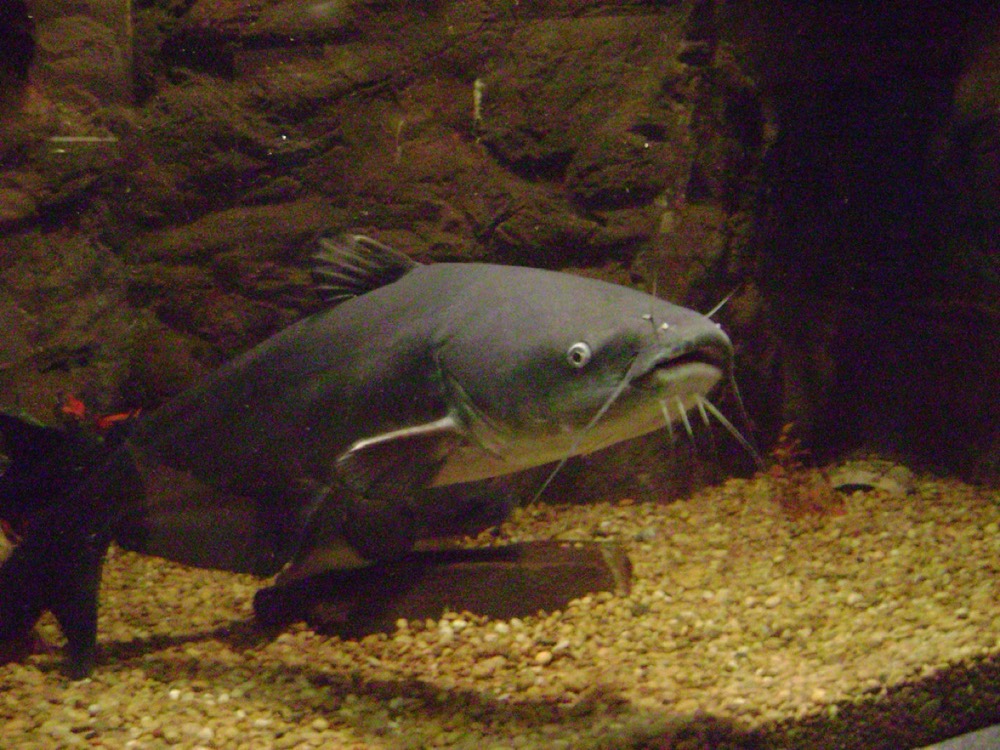
- Barbels (whiskers): Like our other catfish, blue catfish have smooth, scaleless skin and barbels ("whiskers") around the mouth.
- Tail shape: Like the channel catfish, this species has a deeply forked tail.
- Anal fin shape: The anal fin is straight-edged (not rounded); it tapers toward the back in a flat line, like a barber's comb.
- Anal fin ray count: The anal fin has 30-35 rays, more than in the channel catfish.
- Body markings: It never has dark spots on the back and sides.
- Body shape: The profile of the back, from the dorsal fin forward, is steeply sloping and straight, giving the head and forward part of the body a distinctly wedge-shaped appearance.
Blue Catfish vs Channel Catfish
The channel catfish has the outer margin of the anal fin rounded outward rather than straight, and the anal fin has fewer rays (usually 24-29). See the Channel Catfish page for its full mark list.
Where it lives
A big-river fish, preferring swift chutes and pools with noticeable current, and silt-free substrates of sand, gravel, and rubble. Native to the Mississippi River basin from western Pennsylvania to southern South Dakota and the Platte River in southwestern Nebraska, south to the Gulf Coast; also found in Gulf Coast tributaries, including the Mobile Bay drainage in Alabama and the Rio Grande drainage in Texas and New Mexico.
How to photograph it for identification
Lay the fish flat on its side in even light and photograph the whole body first, then the details below. Spread the tail fin so its shape (forked, rounded or square) is clear. Get a close, sharp frame of the head: mouth, jaw length and any barbels. Raise the dorsal and anal fins fully; ray counts and fin edges only read when the fin is spread. Shoot the side of the body before the fish dries; spots and stripes fade fast out of water. The app reads the photo and names the likely species; use the marks on this page to confirm it.
Before you keep it
Size and daily limits for this species differ by state and by water, and some waters are catch-and-release only. Check the current regulations for where you are fishing before keeping any fish; if you are unsure of the species, release it.
Is a 'blue channel catfish' a separate fish?
No. 'Blue channel catfish' is a mix of two names: the blue catfish, Ictalurus furcatus, and the channel catfish, Ictalurus punctatus. They are closely related, share big rivers and reservoirs, and both have deeply forked tails, so anglers confuse them. Capt. Richard Simms, writing for Catfish Now, notes that on the Tennessee River channel catfish are often a brilliant golden colour while blues are blue, but warns that large channel cats can look just as blue, so colour cannot settle it.
Blue vs channel catfish: the checklist
- Anal fin edge: blue straight, like a comb; channel rounded outward (Missouri Department of Conservation; Virginia DWR)
- Anal fin rays: blue 30-35, channel 24-29 (Catfish Now; MDC). Wikipedia gives 30-36 and 25-29. This is the most reliable single test
- Spots: blues never have dark spots; channel cats usually do, but the spots can be missing in the smallest young and in large adults. Virginia DWR says channel cats under 20 inches typically have many spots
- Body shape: blues are wedge-shaped with a hump in front of the dorsal fin (Wikipedia); the channel cat's back slopes more gently (MDC)
- Size: channel cats average 2-4 lb, with a record of 58 lb from South Carolina in 1964 (Wikipedia); blues commonly reach 20-40 lb (TPWD), with a 143 lb world record (Virginia DWR)
If you release the fish, count the anal fin rays from a photo. Spread the anal fin flat and photograph it side on; FishLens names the likely species from the photo, and you can confirm with the ray count.
How big blue catfish get
Figures from each agency:
- World and Virginia record: 143 lb, Buggs Island (Kerr) Lake, 2011 (Virginia DWR; Wikipedia)
- Texas rod-and-reel record: 121.5 lb (TPWD)
- Typical: TPWD says blues commonly reach 20 to 40 lb; MDC gives 3 to 40 lb and 20 to 44 inches; the Chesapeake Bay Program says most are under two feet
- Historic giants: fish over 350 lb were reported from the Mississippi River in the late 1800s (TPWD); MDC puts one such report at 315 lb, and says fish over 100 lb were common in Missouri waters before 1900
MDC's page gives modern records in the 115 to 130 lb range, older than the 2011 record; we list both so you can see where the numbers come from.
How old is a 20 lb blue catfish?
There is no fixed age for a 20 lb blue catfish, because growth depends on the water, food supply and how crowded the population is. None of the agency pages we checked gives an age for a set weight. What they do give:
- Lifespan: average 9 to 10 years, maximum 25 (Virginia DWR; Chesapeake Bay Program); MDC says at least 21 years in the wild; Wikipedia says up to 20
- Growth: faster than the channel catfish and nearly equal to the flathead catfish (MDC)
- Maturity: at about 24 inches long (TPWD)
So a 20 lb blue is a mature adult, but it could be young in a fast-growing reservoir or much older in a crowded river.
Is blue catfish good to eat?
Blue catfish are a popular food fish. TPWD calls them an excellent food fish and the second most preferred fish group among Texas licensed anglers, and MDC describes firm, well-flavoured flesh. Channel catfish are eaten even more widely: Wikipedia says they make up 90% of US farm-raised catfish.
Wild fish are a different matter from farmed fish. Virginia DWR tells anglers to follow the Virginia Department of Health consumption advisories before eating blue catfish, and encourages keeping smaller fish. Check the advisory for the exact river or lake you fished.
Outside their native range, blues are a problem. Wikipedia describes them as problematic invasives in Virginia's Chesapeake Bay region. Virginia DWR stocked them in the James and Rappahannock rivers in 1974, and Wikipedia reports catch rates in Chesapeake Bay tributaries above 6,000 fish an hour against about 700 in their native range, with blue crab a regular part of their diet.
FAQ
What does a Blue Catfish look like?
Like our other catfish, blue catfish have smooth, scaleless skin and barbels ("whiskers") around the mouth. Like the channel catfish, this species has a deeply forked tail.
How big does a Blue Catfish get?
Adult length is commonly 20-44 inches, with weight commonly 3-40 pounds; recent record weights are in the 115-130 pound range, and specimens over 300 pounds were reported in the 1800s.
How do I tell a Blue Catfish from a Channel Catfish?
The channel catfish has the outer margin of the anal fin rounded outward rather than straight, and the anal fin has fewer rays (usually 24-29).
Where are Blue Catfish found?
Native to the Mississippi River basin from western Pennsylvania to southern South Dakota and the Platte River in southwestern Nebraska, south to the Gulf Coast; also found in Gulf Coast tributaries, including the Mobile Bay drainage in Alabama and the Rio Grande drainage in Texas and New Mexico.
How big do blue channel catfish get?
If you mean blue catfish: commonly 20 to 40 lb (TPWD), with a world record of 143 lb from Kerr Lake in 2011 (Virginia DWR). Channel catfish are smaller, 2 to 4 lb on average, record 58 lb (Wikipedia).
Is blue channel catfish good to eat?
Both blue and channel catfish are popular food fish; TPWD calls the blue an excellent food fish. Check your state's fish consumption advisory before eating wild catfish, especially large ones.
What's the difference between a channel catfish and a blue catfish?
Look at the anal fin: straight-edged with 30-35 rays on a blue, rounded with 24-29 rays on a channel cat. Channel cats usually have dark spots; blues never do (MDC).
How old is a 20 lb blue catfish?
It varies with the water; no agency we checked gives an age for a set weight. Blues average 9 to 10 years and can live 25 (Virginia DWR), and they grow faster than channel catfish (MDC).
More in North American Fish Identification
Related
See what's really swimming there.
Start with a single photo.
Found one? Take a photo to identify it.
Sources
- Missouri Dept. of Conservationmdc.mo.gov/discover-nature/field-guide/blue-catfish
- nas.er.usgs.govnas.er.usgs.gov/queries/FactSheet.aspx?SpeciesID=740
- catfishnow.comcatfishnow.com/channel-cats-vs-blue-cats-know-the-difference-by-capt-richard-sim
- Texas Parks & Wildlifetpwd.texas.gov/huntwild/wild/species/blc/
- Wikipediaen.wikipedia.org/wiki/Blue_catfish
- dwr.virginia.govdwr.virginia.gov/wildlife/information/blue-catfish/
- chesapeakebay.netwww.chesapeakebay.net/discover/field-guide/entry/blue-catfish
- Wikipediaen.wikipedia.org/wiki/Channel_catfish
Compiled by the FishLens editorial team
Every fact on this page is taken from the sources listed above; numbers and prices are copied from the source, and prices name the guide or auction and its date. Research and drafting were assisted by AI, and each claim was then checked against the cited sources. Checked 2026-09-25. We do not buy, sell or grade items; the app identifies what you photograph and points you to these references.