
Alligator Gar: ID, Size, Records and Toxic Eggs
Quick answer
Alligator gar top 300 lb; the rod-and-reel record is 283 lb (Sam Rayburn Lake, 2023). ID marks, toxic eggs, state rules and why they don't attack people.
Updated 2026-09-25 · Sources: floridamuseum.ufl.edu, Texas Parks & Wildlife, Wikipedia, myfwc.com
Found one? Take a photo to identify it.
Download on the App StoreWhat are the key facts?
- Scientific name: Atractosteus spatula
- Family: Lepisosteidae (Gar)
- Adult size: Commonly grows to about 6.5 feet (2 m) and over 100 pounds; the largest recorded specimens reach about 10 feet (3 m) and 350 pounds.
- Habitat: Lives in large, slow-moving rivers, reservoirs, oxbow lakes, bayous, and bays, in both fresh and brackish water.
- Range in North America: Ranges from the Florida Panhandle, through the Gulf Coastal Plain and the Mississippi River basin, north to the lower Ohio and Missouri Rivers, and southwest through Texas to Veracruz, Mexico.
Key marks to check on a Alligator Gar
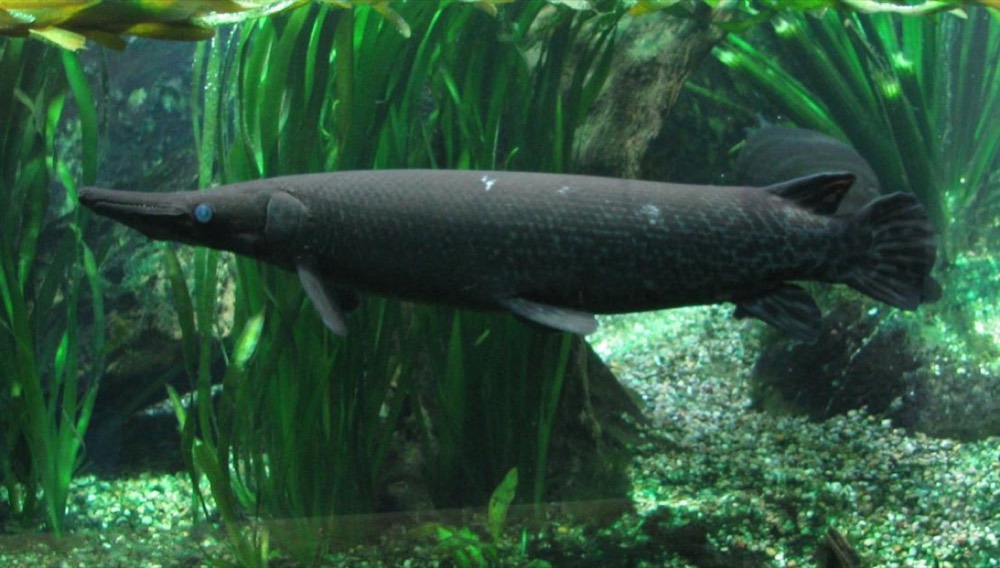
- Snout shape: A relatively short, broad snout, alligator-like when viewed from above.
- Teeth: Two rows of fang-like teeth in the upper jaw.
- Scale type: The body is covered in ganoid scales — thick, overlapping scales that form a protective covering similar to medieval chainmail.
- Body shape: An elongated, torpedo-shaped body.
- Body markings: Adult specimens lack spots on the body (juveniles show a pale mid-dorsal stripe and a dark lateral band).
- Coloration: Dark olive-green on top, fading to yellowish white on the belly.
Alligator Gar vs Longnose Gar
The alligator gar has a distinctly short, wide snout (alligator-like when viewed from above); the longnose gar has a long, narrow snout with single rows of teeth. See the Longnose Gar page for its full mark list.
Where it lives
Lives in large, slow-moving rivers, reservoirs, oxbow lakes, bayous, and bays, in both fresh and brackish water. Ranges from the Florida Panhandle, through the Gulf Coastal Plain and the Mississippi River basin, north to the lower Ohio and Missouri Rivers, and southwest through Texas to Veracruz, Mexico.
How to photograph it for identification
Lay the fish flat on its side in even light and photograph the whole body first, then the details below. Get a close, sharp frame of the head: mouth, jaw length and any barbels. Photograph the gill cover and cheek straight on so the ear flap and scale rows are visible. Shoot the side of the body before the fish dries; spots and stripes fade fast out of water. The app reads the photo and names the likely species; use the marks on this page to confirm it.
Before you keep it
Size and daily limits for this species differ by state and by water, and some waters are catch-and-release only. Check the current regulations for where you are fishing before keeping any fish; if you are unsure of the species, release it.
Is it safe to swim with alligator gar? Are they aggressive?
Alligator gar do not attack swimmers. Texas Parks and Wildlife (TPWD) states that there are no confirmed attacks on people, describes the fish as often sluggish and docile, and explains that its teeth are built for holding and subduing prey rather than tearing chunks from it the way a shark's do. Wikipedia's review of the history reaches the same conclusion: decades of claimed attacks remain unsubstantiated, apart from injuries caused by captured gar thrashing on boat decks.
That last point is where the real risk sits. TPWD says the only time alligator gar pose danger to people is when anglers land and handle them, and recommends:
- Landing the fish with a rope lasso, a large net or a cradle rather than by hand
- Wearing cut-resistant gloves
- Keeping clear of the mouth and the tail
- Watching your footing, because the fish's slime is very slippery and causes falls
Gar are not aggressive towards people, so the answer to "are gars aggressive" is no in the water and "handle with care" on the boat.
Can you eat alligator gar? Why the eggs matter
This page does not tell you any gar is safe to eat. What the agencies say:
- The eggs are toxic. TPWD states that alligator gar eggs are toxic and may cause sickness if eaten; Wikipedia describes them as bright red and poisonous to humans. Florida FWC notes they are toxic to crayfish and small rodents too, which may deter egg predators.
- Contaminant advisories apply in some waters. TPWD notes that Texas Department of State Health Services consumption advisories for alligator gar and other gars cover several systems, including Lake Livingston and the Trinity River, where no consumption is advised, and that upper Lavaca Bay (Calhoun County) and the Donna Irrigation System (Hidalgo County) are under bans that require every fish caught to be released. Check the current Texas Outdoor Annual or your own state's health advisories before keeping any fish.
- The flesh has a market. TPWD describes the flesh as white and firm with a mild taste, commercial fisheries exist in some southern states, and Wikipedia records wholesale prices for wild gar meat between $1.00 and $2.50 per pound, with retail prices of $3.00 to $3.50 per pound.
So "why don't we eat gar?" has several answers: the roe is poisonous, some waters carry do-not-eat advisories, the armour of interlocking ganoid scales (which Wikipedia calls nearly impenetrable) makes cleaning hard work, and for about half a century agencies treated gar as a trash fish to be eliminated, which shaped attitudes that still linger. If anyone becomes ill after eating gar roe, call Poison Control (1-800-222-1222 in the US) or emergency services.
Records, age and spawning
Record lists for alligator gar go out of date, so check the date on any page you read. Wikipedia gives these records:
- Rod and reel, world and Texas record: 283 lb, caught by Arthur Weston on 2 September 2023 at Sam Rayburn Lake, Texas
- Texas bowfishing record: 290 lb, Trinity River, 2001
- All-tackle record: 302 lb, trotline, 1953
A TPWD fast-facts page still lists the state rod-and-reel record as 279 lb from the 1950s and gives a 327 lb, 8 ft 5 in netted fish from Mississippi in 2011 as the world record. That page predates the 2023 catch, which is one of the gaps this page fills.
These are slow fish to mature. TPWD says alligator gar do not reproduce until about 10 years old and may live to almost 100; Florida FWC also puts maturity at around 10 years. Spawning happens in late spring, usually April or May, once water passes 68F, in shallow water among half-submerged vegetation (TPWD). A female is estimated to produce about 4.1 eggs per gram of body weight, around 150,000 eggs per spawn on average, and the sticky eggs hatch within a few days (Wikipedia).
Rules differ by state
Whether you can keep an alligator gar depends heavily on where you are:
- Texas: a one-per-day bag limit has applied since 2009 (Wikipedia). TPWD's fast-facts page gives 1 per day of any size, except Falcon Reservoir at 5 per day, and TPWD lists special rules for the Trinity River and Lake Livingston, including a drawing system for harvest, along with harvest reporting requirements. Confirm the current Outdoor Annual before you fish.
- Florida: no take of alligator gar is allowed without a permit, a rule in place since 2006 (Florida FWC). In Florida the species is restricted to six rivers in the western Panhandle and the bays they feed.
- Other states: Oklahoma, Texas, Arkansas, Mississippi and Louisiana allow regulated sport fishing (Wikipedia), and several states now protect the species after decades of eradication efforts.
If you are not certain a fish is an alligator gar rather than a longnose gar, photograph it before release; the app and the snout comparison above will settle it.
Alligator gar outside North America
Alligator gar sold as pets have turned up far from home. Wikipedia records the species as invasive in mainland China, where it is sold as an exotic pet, with sightings in eight provinces reported in August 2022 and authorities working to remove it. In September 2009 a 3 ft 3 in alligator gar was found in a park pond in Tsuen Wan, Hong Kong, and over the next two days at least 16 more turned up in park ponds, the largest 4.9 ft.
Wikipedia also notes that many fish labelled alligator gar in the aquarium trade are actually smaller gar species, and that keeping alligator gar as pets is illegal in many areas. A juvenile that fits a home tank today can pass 6 ft; never release one, and report any gar found outside its native range to the local fisheries authority.
How rare is an alligator gar?
Worldwide it is not listed as threatened: the IUCN rates the alligator gar as Least Concern (Wikipedia). Locally it can be very rare. Wikipedia reports the species is now extirpated from west-central Illinois, Ohio, Kansas, Nebraska and Iowa, and that across much of its old northern range valid sightings now come only once every few years; the northernmost verified catch was at Meredosia, Illinois, in 1922.
Today the main populations are in Texas, Louisiana, Oklahoma, Mississippi and Arkansas, extending into Mexico. After decades of culling as a "trash fish", attitudes changed: management work began in the 1980s, the Missouri Department of Conservation worked with nine other states on restoration, and in 2016 fish were reintroduced between Tennessee and Illinois, partly to help control invasive Asian carp (Wikipedia). So an alligator gar is a common sight in parts of Texas and a rare, protected find farther north.
It belongs to an old family. There are only seven living gar species in two genera, Atractosteus (alligator, Cuban and tropical gar) and Lepisosteus (spotted, Florida, longnose and shortnose gar), and the lineage goes back more than 240 million years (Wikipedia). All gars can gulp air using a swim bladder that works as a lung, which lets them live in warm, low-oxygen backwaters.
What people mean by 'alligator fish'
Most searches for 'alligator fish' are about the alligator gar, which Wikipedia notes is sometimes called the alligator fish. But the name also belongs to a completely different animal, and news stories add to the confusion:
- Alligator gar (Atractosteus spatula): the large North American gar on this page, with a broad, alligator-like snout
- Alligatorfish (Aspidophoroides monopterygius): a small, armoured poacher from the cold northwest Atlantic, from western Greenland and Labrador to Cape Cod. It is long and narrow, reaches only 22 cm, and lives on sand and mud bottoms usually 60 to 150 m deep (FishBase)
- The 'prehistoric fish' in Singapore: in February 2021 a large carcass found on the bank of MacRitchie Reservoir was identified as an alligator gar. Mothership.sg reported that the species is not native to Singapore and that fish found there were probably released pets that outgrew their tanks; a 1.5 m gar had been caught in a Pasir Ris canal in 2011
If a photo shows a long fish with a flat, broad snout and rows of teeth, you are almost certainly looking at an alligator gar. FishLens suggests a name from one photo.
Is it legal to shoot alligator gar in Texas?
Yes, within the rules. Texas Parks and Wildlife's Outdoor Annual says alligator gar may be taken by any legal means, including archery equipment and crossbows, subject to these limits (checked 25 September 2026):
- Statewide: 1 alligator gar per day, any size
- Falcon International Reservoir: 5 per day, possession limit 10
- Trinity River rules: only gar under 48 inches may be kept, except by anglers selected in an annual drawing, whose applications open 1 to 30 September; and between half an hour after sunset and half an hour before sunrise, no one may take or possess an alligator gar with archery equipment or a crossbow unless they hold a harvest authorisation
- Reporting: every alligator gar harvested from public waters, except Falcon, must be reported to TPWD within 24 hours through the mobile app or online
Rules change, so check the current Outdoor Annual before each trip. Firearms are a separate question that this page does not cover; ask TPWD.
FAQ
What does a Alligator Gar look like?
A relatively short, broad snout, alligator-like when viewed from above. Two rows of fang-like teeth in the upper jaw.
How big does a Alligator Gar get?
Commonly grows to about 6.5 feet (2 m) and over 100 pounds; the largest recorded specimens reach about 10 feet (3 m) and 350 pounds.
How do I tell a Alligator Gar from a Longnose Gar?
The alligator gar has a distinctly short, wide snout (alligator-like when viewed from above); the longnose gar has a long, narrow snout with single rows of teeth.
Where are Alligator Gar found?
Ranges from the Florida Panhandle, through the Gulf Coastal Plain and the Mississippi River basin, north to the lower Ohio and Missouri Rivers, and southwest through Texas to Veracruz, Mexico.
Is it safe to swim with an alligator gar?
Alligator gar do not attack swimmers. TPWD reports no confirmed attacks on people and describes the fish as often sluggish and docile. The only danger it names is to anglers landing and handling large fish, which is why it recommends nets or cradles, cut-resistant gloves and staying clear of the mouth and tail.
Is alligator gar a good fish to eat?
TPWD describes the flesh as white, firm and mild, and it is sold commercially in some southern states. But the eggs are toxic and can make people sick, and some Texas waters, including Lake Livingston and the Trinity River, carry advisories against eating gar at all. Check your state's current health advisories; this page does not call any gar safe to eat.
Are gars aggressive?
Not towards people. Claimed attacks on humans remain unconfirmed; the injuries on record come from captured gar thrashing on boat decks. Alligator gar are predators of fish, birds and small mammals, and they do defend themselves hard when landed.
Why don't we eat gar?
Several reasons: the roe is poisonous to people, some waters have do-not-eat advisories because of contaminants, the armour of ganoid scales makes cleaning hard, and for decades agencies labelled gar a trash fish. People in parts of the southern US do eat the fillets.
How rare is an alligator gar?
Globally it is Least Concern (IUCN), but it has vanished from west-central Illinois, Ohio, Kansas, Nebraska and Iowa, and northern sightings are now years apart; it remains common in parts of Texas and Louisiana (Wikipedia).
What is an alligator fish?
Usually the alligator gar (Wikipedia). The name also belongs to the alligatorfish, a 22 cm armoured poacher of the cold northwest Atlantic (FishBase).
Is it legal to shoot alligator gar in Texas?
Yes with archery gear or crossbows, within a 1-per-day statewide limit, Trinity River night and length rules, and 24-hour harvest reporting (TPWD Outdoor Annual, checked 25 September 2026).
Why was an alligator gar found in Singapore?
It is not native there; Mothership.sg reported that gar found in Singapore were probably released pets, after a carcass turned up at MacRitchie Reservoir in February 2021.
More in North American Fish Identification
Related
See what's really swimming there.
Start with a single photo.
Found one? Take a photo to identify it.
Sources
- floridamuseum.ufl.eduwww.floridamuseum.ufl.edu/discover-fish/species-profiles/alligator-gar
- Texas Parks & Wildlifetpwd.texas.gov/fishboat/fish/management/alligator-gar/identify-gar.phtml
- Wikipediaen.wikipedia.org/wiki/Alligator_gar
- Texas Parks & Wildlifetpwd.texas.gov/fishboat/fish/management/alligator-gar/
- Texas Parks & Wildlifetpwd.texas.gov/fishboat/fish/management/alligator-gar/no-threat.phtml
- Texas Parks & Wildlifetpwd.texas.gov/fishboat/fish/management/alligator-gar/edible.phtml
- Texas Parks & Wildlifetpwd.texas.gov/newsmedia/releases/news_roundup/alligator_gar/alligator_gar_fast_
- myfwc.commyfwc.com/wildlifehabitats/profiles/freshwater/alligator-gar/
- Texas Parks & Wildlifetpwd.texas.gov/huntwild/wild/species/alg/
- Wikipediaen.wikipedia.org/wiki/Gar
- Wikipediaen.wikipedia.org/wiki/Alligator_fish
- fishbase.sefishbase.se/summary/SpeciesSummary.php?id=4157
- mothership.sgmothership.sg/2021/02/alligator-gar-carcass-macritchie/
- Texas Parks & Wildlifetpwd.texas.gov/regulations/outdoor-annual/fishing/freshwater-fishing/gar-closure
Compiled by the FishLens editorial team
Every fact on this page is taken from the sources listed above; numbers and prices are copied from the source, and prices name the guide or auction and its date. Research and drafting were assisted by AI, and each claim was then checked against the cited sources. Checked 2026-09-25. We do not buy, sell or grade items; the app identifies what you photograph and points you to these references.