
Perca flavescens (Yellow Perch): ID, Size and Eating
Quick answer
Perca flavescens, the yellow perch: 6-8 dark bars, two separate dorsal fins, up to 50 cm. How to tell it from walleye, and why Lake Erie perch costs more.
Updated 2026-09-25 · Sources: Missouri Dept. of Conservation, Animal Diversity Web, Minnesota DNR, Wikipedia
Found one? Take a photo to identify it.
Download on the App StoreWhat are the key facts?
- Scientific name: Perca flavescens
- Family: Percidae (Perch family)
- Adult size: Adult length is 6-8 inches; weight is usually 4 ounces to 1 pound.
- Habitat: A freshwater fish, primarily found in lakes, also occurring in still-water environments such as impoundments.
- Range in North America: Ranges from west-central Canada and the Hudson Bay area east to New Brunswick, south to South Carolina, and west to Kansas.
Key marks to check on a Yellow Perch
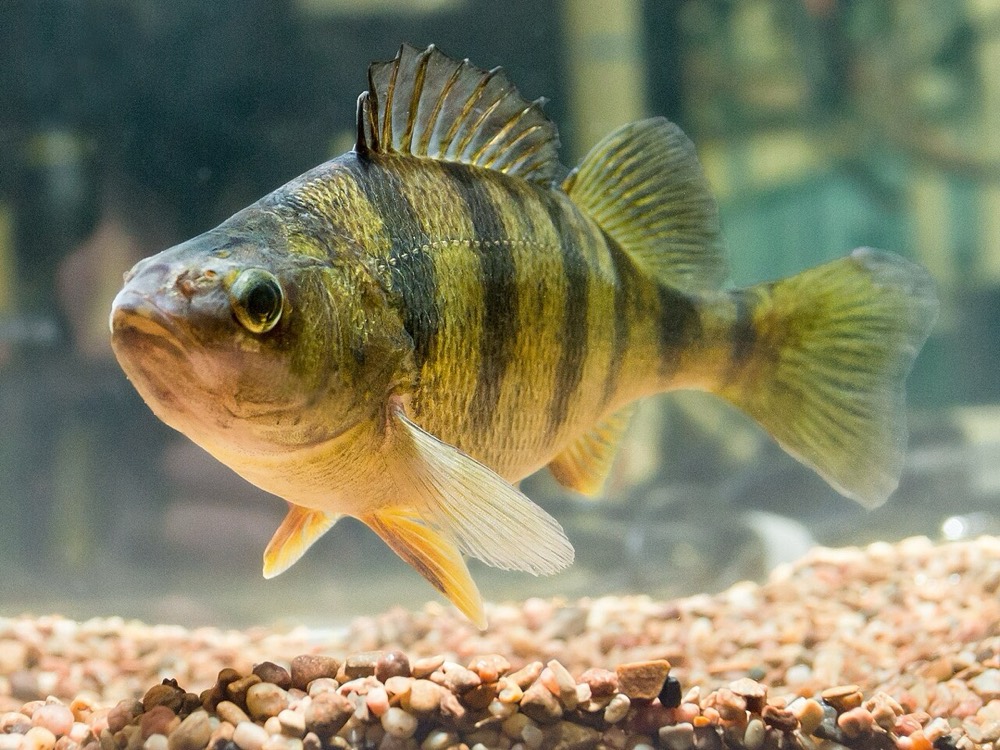
- Body shape: A rather deep, slab-sided fish that is nearly sunfish-shaped.
- Dorsal fin: There are 2 fully separate dorsal fins (a spiny one in front, a soft one behind).
- Body markings: 6-8 regularly spaced dark bars cross the back and extend vertically onto the sides.
- Jaw length: The upper jaw extends back about as far as the middle of the eye, and the teeth are small and inconspicuous — quite unlike the large canine teeth of the walleye and sauger.
Yellow Perch vs Walleye
The yellow perch lacks the large, prominent teeth found in walleye and sauger, which can be used to tell them apart. See the Walleye page for its full mark list.
Yellow Perch vs Eurasian Ruffe
The ruffe resembles a yellow perch with walleye-like markings, but its head lacks scales, and its dorsal fin is a single spiny fin rather than the yellow perch's two separate dorsal fins.
Where it lives
A freshwater fish, primarily found in lakes, also occurring in still-water environments such as impoundments. Ranges from west-central Canada and the Hudson Bay area east to New Brunswick, south to South Carolina, and west to Kansas.
How to photograph it for identification
Lay the fish flat on its side in even light and photograph the whole body first, then the details below. Get a close, sharp frame of the head: mouth, jaw length and any barbels. Raise the dorsal and anal fins fully; ray counts and fin edges only read when the fin is spread. Shoot the side of the body before the fish dries; spots and stripes fade fast out of water. The app reads the photo and names the likely species; use the marks on this page to confirm it.
Before you keep it
Size and daily limits for this species differ by state and by water, and some waters are catch-and-release only. Check the current regulations for where you are fishing before keeping any fish; if you are unsure of the species, release it.
What kind of fish is Perca?
Perca is the genus of true perches in the perch family, Percidae, the same family as walleye and sauger. Perca flavescens, the yellow perch, is North America's species. Its closest relative is the European perch, Perca fluviatilis; Wikipedia notes the two are so similar that the yellow perch has sometimes been treated as a subspecies, and the two can interbreed.
How to tell them apart if you fish on both continents: the European perch has five to eight dark vertical bars and, as it matures, develops a hump between the head and the dorsal fin (Wikipedia). It also grows larger, to a documented 60 cm, with an IGFA record of 2.9 kg from Finland in 2010. Outside Europe it is an invasive problem; in Australia, where it is called redfin, it is classed as a noxious species in New South Wales.
Yellow perch life history in numbers
- Size: common length 19.1 cm (7.5 in), maximum 50 cm (19.7 in) (FishBase, US Fish and Wildlife Service)
- Record: 1.9 kg (4 lb 3 oz), caught in May 1865 at Bordentown, New Jersey, still the IGFA world record (Wikipedia)
- Age: most live 9 to 10 years; FishBase gives a maximum reported age of 11
- Maturity: males at 2 to 3 years, females at 3 to 4 (Wikipedia)
- Spawning: females lay gelatinous egg strands of 10,000 to 40,000 eggs over vegetation, a habit Wikipedia calls unique among North American freshwater fish; eggs hatch roughly 12 days after fertilisation, depending on temperature (US Fish and Wildlife Service)
- Depth and temperature: 0 to 56 m, usually 0 to 9 m; 0 to 30 C (FishBase)
- Status: Least Concern on the IUCN Red List, assessed 2012 (FishBase)
The US Fish and Wildlife Service describes the stripes as 6 to 8 triangular olive-green bars, which matches the 6 to 8 dark bars listed as a key mark above.
Is yellow perch a good eating fish?
Yellow perch is one of the most valued food fish of the Great Lakes. The US Food and Drug Administration puts perch, both freshwater and ocean, in its 'Best Choices' group, its lowest-mercury category, and FishBase notes the flesh provides protein (17.5%), calcium, selenium and omega-3 fatty acids.
For fish you catch yourself, contaminant levels depend on the lake or river, not just the species, so check your state's fish consumption advisory for that water before eating it, and keep to its size and daily limits.
The European perch is also widely eaten. Wikipedia describes its meat as white, firm and flaky and reports a global commercial catch of 28,920 tonnes in 2013, mainly from Russia, Finland and Estonia.
Why is yellow perch so expensive?
Because demand is steady and the main commercial supply, Lake Erie, is catching fewer fish. A CP24 report of 24 July 2026 describes yellow perch as the highest-value species in Lake Erie's commercial fishery, which brings in roughly 80% of Ontario's commercial fishing revenue, worth over $200 million a year. A commercial crew member told CP24 the catch was 'next to nothing'.
The causes cited in that report:
- Walleye: the Ontario Commercial Fisheries Association said walleye numbers have run at 50 to 100 million a year from 2020 to 2026, 'way above normal', and adult perch are walleye prey
- Cormorants: nests rose from fewer than 90 in 1979 to over 13,000 by the mid-2000s, though the association said there is no quantifiable evidence linking them to the current decline
The fishery has recovered before: CP24 notes a severe drop in 1995 to 1996 followed by a rebound within a couple of years. Farming is not a large alternative yet; Wikipedia puts US Midwest aquaculture at about 90,800 kg a year.
FAQ
What does a Yellow Perch look like?
A rather deep, slab-sided fish that is nearly sunfish-shaped. There are 2 fully separate dorsal fins (a spiny one in front, a soft one behind).
How big does a Yellow Perch get?
Adult length is 6-8 inches; weight is usually 4 ounces to 1 pound.
How do I tell a Yellow Perch from a Walleye?
The yellow perch lacks the large, prominent teeth found in walleye and sauger, which can be used to tell them apart.
Where are Yellow Perch found?
Ranges from west-central Canada and the Hudson Bay area east to New Brunswick, south to South Carolina, and west to Kansas.
Is yellow perch a good eating fish?
It is one of the Great Lakes' most valued food fish, and the FDA lists perch among its 'Best Choices', the lowest-mercury group. For fish you catch, check your state's consumption advisory for that water first.
Why is yellow perch so expensive?
Lake Erie, the main commercial source, is producing fewer perch. CP24 (24 July 2026) reports perch is the lake's highest-value commercial species and links the decline to very high walleye numbers, with cormorants a possible but unproven factor.
What kind of fish is Perca?
Perca is the genus of true perches in the family Percidae, which also includes walleye. It contains the North American yellow perch, Perca flavescens, and the European perch, Perca fluviatilis, which are close enough to interbreed (Wikipedia).
Is European perch good to eat?
It is widely eaten in Europe; Wikipedia describes the meat as white, firm and flaky and records a global catch of 28,920 tonnes in 2013. As with any wild fish, follow local advice for the water it came from.
More in North American Fish Identification
Related
See what's really swimming there.
Start with a single photo.
Found one? Take a photo to identify it.
Sources
- Missouri Dept. of Conservationmdc.mo.gov/discover-nature/field-guide/yellow-perch
- Animal Diversity Webanimaldiversity.org/accounts/Perca_flavescens/
- Minnesota DNRwww.dnr.state.mn.us/invasives/aquaticanimals/ruffe/index.html
- Wikipediaen.wikipedia.org/wiki/Yellow_perch
- U.S. Fish & Wildlife Servicewww.fws.gov/species/yellow-perch-perca-flavescens
- fishbase.sewww.fishbase.se/summary/359
- Wikipediaen.wikipedia.org/wiki/European_perch
- fda.govwww.fda.gov/food/consumers/advice-about-eating-fish
- cp24.comwww.cp24.com/local/hamilton/2026/07/24/lake-eries-yellow-perch-plunge-walleye-su
Compiled by the FishLens editorial team
Every fact on this page is taken from the sources listed above; numbers and prices are copied from the source, and prices name the guide or auction and its date. Research and drafting were assisted by AI, and each claim was then checked against the cited sources. Checked 2026-09-25. We do not buy, sell or grade items; the app identifies what you photograph and points you to these references.