
Bluegill: ID Marks, Record Size, Eating and Catching
Quick answer
Bluegill (Lepomis macrochirus) is a sunfish, not a bass or crappie. World record 4 lb 12 oz, Alabama, 1950. ID marks, how to catch it and eating advice.
Updated 2026-09-25 · Sources: Minnesota DNR, fishofohio.com, invasions.si.edu, Wikipedia
Found one? Take a photo to identify it.
Download on the App StoreWhat are the key facts?
- Scientific name: Lepomis macrochirus
- Family: Centrarchidae (Sunfish and black bass)
- Adult size: Grows to 4-8 inches in length and about half a pound in weight on average.
- Habitat: A freshwater fish found in ponds, lakes, and slow-moving rivers.
- Range in North America: Native to the Great Lakes and St. Lawrence and Mississippi River basins, from Quebec and New York south to the Gulf Coast.
Key marks to check on a Bluegill
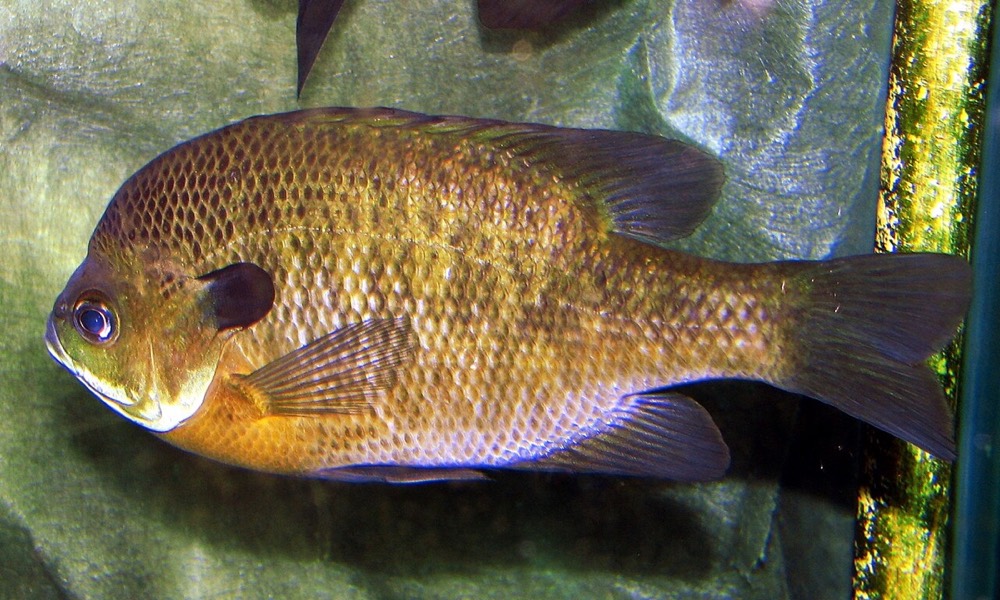
- Body shape: A very round, pan-shaped profile — the classic sunfish body.
- Ear flap color: The ear flap (opercle) is always black, without the red tip seen on the redear sunfish.
- Body markings: 5-9 dark bars on the sides and an overall dark green body color.
- Dorsal fin: Bluegill often have a black blotch near the back of the soft dorsal and anal fins.
- Jaw length: A relatively small mouth.
Bluegill vs Pumpkinseed Sunfish
Bluegill lack the wavy blue lines on the cheek seen on the pumpkinseed sunfish. See the Pumpkinseed Sunfish page for its full mark list.
Bluegill vs Redear Sunfish
The bluegill's ear flap is always black with no red edge, while the redear sunfish's ear flap has a red edge. See the Redear Sunfish page for its full mark list.
Where it lives
A freshwater fish found in ponds, lakes, and slow-moving rivers. Native to the Great Lakes and St. Lawrence and Mississippi River basins, from Quebec and New York south to the Gulf Coast.
How to photograph it for identification
Lay the fish flat on its side in even light and photograph the whole body first, then the details below. Get a close, sharp frame of the head: mouth, jaw length and any barbels. Raise the dorsal and anal fins fully; ray counts and fin edges only read when the fin is spread. Photograph the gill cover and cheek straight on so the ear flap and scale rows are visible. Shoot the side of the body before the fish dries; spots and stripes fade fast out of water. The app reads the photo and names the likely species; use the marks on this page to confirm it.
Before you keep it
Size and daily limits for this species differ by state and by water, and some waters are catch-and-release only. Check the current regulations for where you are fishing before keeping any fish; if you are unsure of the species, release it.
Is a bluegill a crappie or a bass?
Neither. All three are cousins in the sunfish family, Centrarchidae, but each sits in its own genus: bluegill are Lepomis, crappies are Pomoxis, and black basses such as the largemouth are Micropterus.
The differences are easy to see side by side:
- Bluegill: small mouth, round pan-shaped body, solid black ear flap, dark blotch at the back of the soft dorsal fin
- Crappie: genus Pomoxis; see black crappie and white crappie
- Largemouth bass: long body and a huge mouth whose upper jaw reaches past the eye; see largemouth bass
Bass and bluegill share ponds for a reason. Wikipedia lists bass among the main predators of bluegill, and bluegill are sometimes used as bait for largemouth bass and catfish.
How hard is it to catch a bluegill?
Bluegill are among the easiest fish to catch. The Minnesota DNR says they are often the first fish a beginning angler lands, simply because there are so many of them.
What works:
- Bait: a small piece of nightcrawler on a small hook with light line, about 6 lb test (Minnesota DNR); Wikipedia also lists crickets and grasshoppers
- Time of day: early morning and evening are usually best (Minnesota DNR); Wikipedia notes they bite mostly at dawn and dusk
- Season: spring and early summer, when males guard nests and strike at anything nearby. Virginia DWR says spawning starts when the water reaches 70 to 75F, and Wikipedia puts the peak in June at 67 to 80F
- Where: near weeds, submerged wood and docks; Virginia DWR describes them as favouring underwater structure
The hard part is catching big ones. Wikipedia gives a typical length of 4 to 12 inches, and in Montana the state field guide notes they rarely grow large enough to be a desirable sport fish.
Are bluegill good to eat?
Bluegill are a classic panfish, a name Wikipedia ties to their size and the way they are usually cooked, fried whole or as small fillets in a pan.
On contaminants, the Minnesota DNR explains that because bluegill eat mostly invertebrates and sit low in the food chain, toxin build-up is largely not a concern. Minnesota's statewide guidelines reflect that (Minnesota Department of Health, updated August 2026):
- Most adults: sunfish, including bluegill, up to 4 servings a week
- Children under 15, and anyone pregnant or who may become pregnant: 1 serving a week
- For comparison, bass are 1 serving a week and 1 a month respectively
Those guidelines are for Minnesota. Advisories differ by state and by lake, and some waters have specific warnings. The FDA's advice for fish caught by family and friends is to check local advisories, and if there is none, to eat only one serving that week and no other fish. Check your state's advisory before eating fish from a particular water.
Record size, lifespan and spawning
The world-record bluegill weighed 4 lb 12 oz and came from Ketona Lake, Alabama, in 1950 (Wikipedia). The maximum length is just over 16 inches, but most fish are 4 to 12 inches, and the Minnesota DNR gives an average of 4 to 8 inches and about half a pound.
Most bluegill live 5 to 8 years, and exceptional fish reach 11 (Wikipedia).
Spawning is a colony affair. Males fan out dish-shaped nests 6 to 12 inches across in shallow water, often side by side; Wikipedia reports colonies of up to 272 nests. A small female lays around 1,000 eggs and a large one up to 100,000. The Minnesota DNR notes that small males sometimes dart in to fertilise eggs in another male's nest, a tactic biologists call sneaking.
Other names for bluegill
Depending on the region, anglers call bluegill bream or brim, sunny, coppernose, blue joe or baldface (Wikipedia and the Minnesota DNR). Bream in the American South usually means bluegill or another Lepomis sunfish, not the European bream, which is a carp relative.
The bluegill is the state fish of Illinois. It is native east of the Rocky Mountains but has been introduced across much of the world, including Europe, South Africa, Asia and South America; the Montana field guide notes it is not native even in eastern Montana, where it is now widespread.
How this page was made
Research and drafting for this page were assisted by AI and checked line by line against the sources listed below. Every number names the organisation it comes from; where sources disagree we say so rather than pick one silently. Rules and advisories change, so treat the dates given here as the date we checked. If you find an error, tell us and we will correct it.
FAQ
What does a Bluegill look like?
A very round, pan-shaped profile — the classic sunfish body. The ear flap (opercle) is always black, without the red tip seen on the redear sunfish.
How big does a Bluegill get?
Grows to 4-8 inches in length and about half a pound in weight on average.
How do I tell a Bluegill from a Pumpkinseed Sunfish?
Bluegill lack the wavy blue lines on the cheek seen on the pumpkinseed sunfish.
Where are Bluegill found?
Native to the Great Lakes and St. Lawrence and Mississippi River basins, from Quebec and New York south to the Gulf Coast.
Are bluegill fish good to eat?
Bluegill are a popular panfish, usually fried. The Minnesota DNR says toxin build-up is largely not a concern because they feed low in the food chain; Minnesota's guideline is up to 4 servings a week for most adults and 1 a week for children and pregnant people. Check your own state's advisory.
Is a bluegill a crappie?
No. Both are in the sunfish family, but bluegill are genus Lepomis and crappies are genus Pomoxis.
How hard is it to catch a bluegill?
Easy. The Minnesota DNR says they are often a beginner's first fish. A bit of nightcrawler on a small hook near weeds or docks, early or late in the day, usually works, and spawning males in spring bite readily.
Are bluegills a type of bass?
No. They share the sunfish family with the black basses, but bluegill are genus Lepomis and largemouth and smallmouth bass are genus Micropterus. Bass are in fact one of the bluegill's main predators.
What is the world record bluegill?
4 lb 12 oz, caught at Ketona Lake, Alabama, in 1950 (Wikipedia).
More in North American Fish Identification
- How to Identify a White Crappie (Pomoxis annularis)
- How to Identify a Pumpkinseed Sunfish (Lepomis gibbosus)
- How to Identify a Redear Sunfish (Lepomis microlophus)
- How to Identify a Largemouth Bass (Micropterus salmoides)
- How to Identify a Smallmouth Bass (Micropterus dolomieu)
- How to Identify a Spotted Bass (Micropterus punctulatus)
- How to Identify a Black Crappie (Pomoxis nigromaculatus)
Related
See what's really swimming there.
Start with a single photo.
Found one? Take a photo to identify it.
Sources
- Minnesota DNRwww.dnr.state.mn.us/minnaqua/speciesprofile/bluegill.html
- fishofohio.comwww.fishofohio.com/ohio-fish-bluegill-sunfish.htm
- invasions.si.eduinvasions.si.edu/nemesis/species_summary/168141
- Wikipediaen.wikipedia.org/wiki/Bluegill
- fieldguide.mt.govfieldguide.mt.gov/speciesDetail.aspx?elcode=AFCQB11060
- dwr.virginia.govdwr.virginia.gov/wildlife/information/bluegill/
- health.state.mn.uswww.health.state.mn.us/communities/environment/fish/guidelines.html
- fda.govwww.fda.gov/food/consumers/advice-about-eating-fish
Compiled by the FishLens editorial team
Every fact on this page is taken from the sources listed above; numbers and prices are copied from the source, and prices name the guide or auction and its date. Research and drafting were assisted by AI, and each claim was then checked against the cited sources. Checked 2026-09-25. We do not buy, sell or grade items; the app identifies what you photograph and points you to these references.